Available now — shipping worldwide

Flicker-free AC dimming. 5 lines of code.

DimmerLink is a dedicated hardware controller that sits between your MCU and AC dimmer module. It handles all time-critical TRIAC operations — you just send simple commands via UART or I2C.

Buy DimmerLink AliExpress GitHub
arduino — i2c_basic.ino
#include <Wire.h>

void setup() {
  Wire.begin();
}

void loop() {
  Wire.beginTransmission(0x50);
  Wire.write(0x10);  // brightness register
  Wire.write(50);    // 50%
  Wire.endTransmission();
}
Why DimmerLink
Your MCU does the thinking.
DimmerLink does the timing.

A dedicated Cortex-M+ handles zero-cross detection, phase angle calculation, and TRIAC firing with microsecond precision. Your code stays clean and conflict-free.

Zero Flickering

Dedicated processor handles all time-critical operations. No software delays, no interrupt conflicts, no flickering — ever.

📦

No Libraries Required

Send 3–4 byte commands via UART or I2C. Works with any programming language. Arduino, Python, MicroPython, C — literally 5 lines of code.

🔌

Universal Compatibility

Arduino, ESP32, ESP8266, Raspberry Pi, STM32, or any MCU with UART/I2C. Supports 1.8V, 3.3V, and 5V logic levels natively.

📈

Dimming Curves

Built-in Linear, RMS (incandescent), and Logarithmic curves. Automatic 50/60Hz mains detection. 0–100% brightness range.

🔀

Dual Interface

UART (115200 8N1) or I2C — switch by command at any time. Multiple DimmerLinks on one I2C bus with different addresses.

📐

Ultra Compact

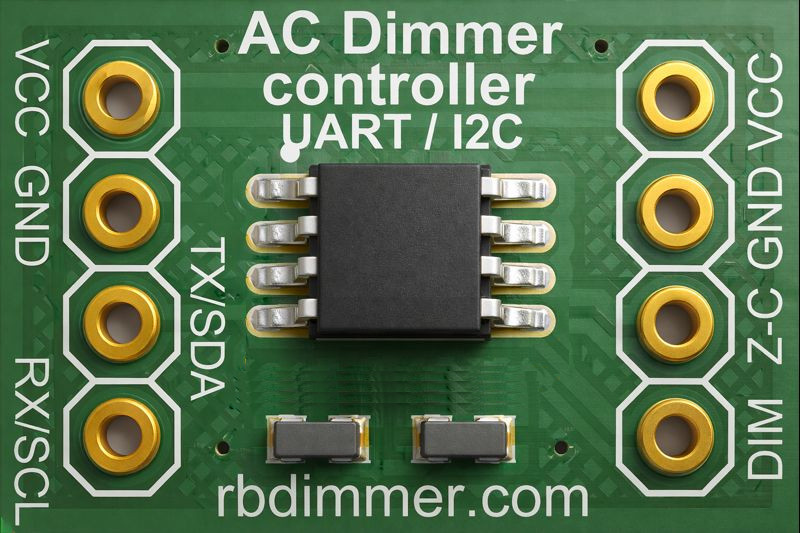
Only 18×12mm. Fits between your controller and any AC dimmer module. Plug & play — working dimmer in 5 minutes.

How it works
Three steps. Five minutes.

Connect, power up, send command.

1

Connect

Wire DimmerLink between your MCU and AC dimmer module. 4 pins: VCC, GND, SDA/TX, SCL/RX.

2

Choose interface

I2C for multi-device setups. UART for simple point-to-point. Switch anytime with a single command.

3

Send command

Write brightness value 0–100. DimmerLink handles zero-cross, phase angle, and TRIAC timing automatically.

Done

Flicker-free dimming. No library conflicts. No interrupts stolen from your main code.
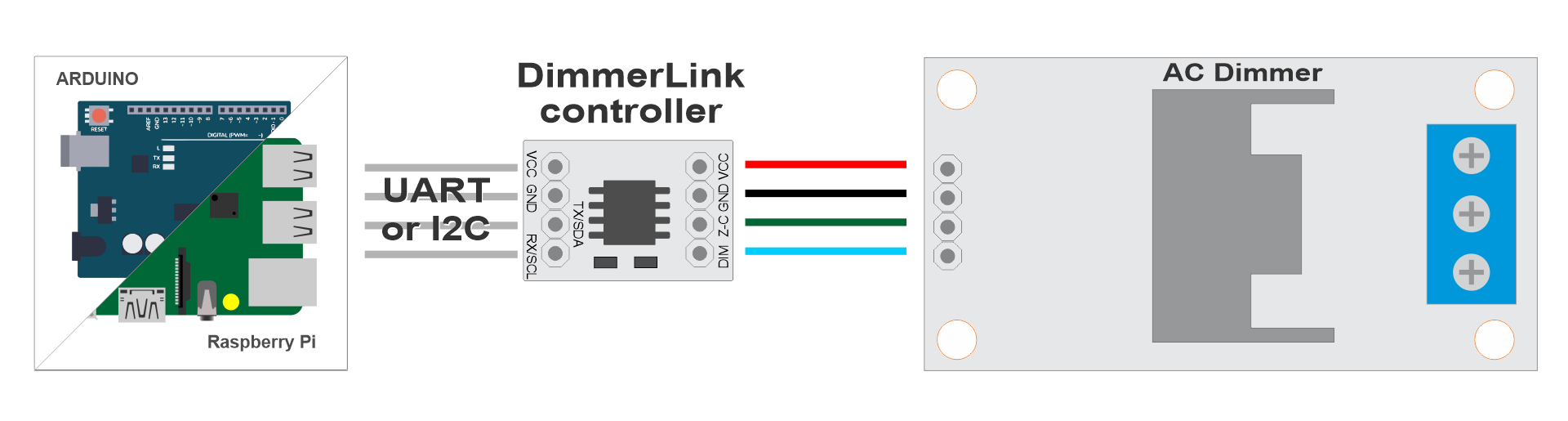
DimmerLink wiring diagram: Arduino or Raspberry Pi connected to AC Dimmer module via DimmerLink controller over UART or I2C

Arduino / Raspberry Pi → DimmerLink → AC Dimmer module. Same wiring for UART and I2C.
Use Cases
Built for real projects.

DimmerLink works anywhere you need precise, reliable AC power control.

💡

Smart Home Lighting

Smooth dimming for incandescent and dimmable LED bulbs via Home Assistant, ESPHome, or Tasmota.

PID Thermal Control

Coffee roasters, sous vide, kilns, reflow ovens. Precise heater control without interrupt conflicts with PID loops.

🌀

Motor & Fan Speed

AC fan speed control, pump regulation, air cleaners. Smooth power delivery without buzzing.

🏭

Industrial & Remote

Connect via LoRa, GSM, Bluetooth, WiFi bridges, or RS-232. No code on the controller — just serial commands.

🧪

Lab & Research

Precise, repeatable power control from any platform — Python, MATLAB, LabVIEW. USB-UART adapter and you're set.

🎓

Education & Prototyping

No complex timer/interrupt code to explain. Students focus on the application, not the TRIAC timing.

Community Builds
Real makers. Real projects.

Makers are switching from SSR to TRIAC dimmers — phase control eliminates the power spikes that SSR on/off switching causes. DimmerLink removes the hardest part.

Coffee Roasters
PID loop via Artisan serial needs tight RoR control. SSR gives coarse on/off steps — dimmer gives proportional heat. One Hackaday build reported "better control and lights stopped flickering" after switching from SSR to TRIAC.
✓ Phase control = finer RoR
🔨
Reflow Ovens
Toaster oven builds (1000–1800W) need a precise thermal profile: preheat → soak → reflow. Replacing SSR with a dimmer module gave "significantly finer temperature control" — a direct quote from a reviewed Hackaday build.
✓ Proven improvement over SSR
🌎
Solar PV Diverters
Proportional TRIAC control is the core of any solar router — divert exactly the surplus power to a water heater. Projects like F1ATB's diverter spend half their docs on analog CT-sensor wiring because the MCU can't handle TRIAC timing alone. DimmerLink solves that.
✓ TRIAC is the core component
🍺
Homebrew (Beer & Spirits)
Immersion heaters in mash tuns and boil kettles (2–5.5 kW) have always relied on SSR wave-packet switching. Community forums show a growing shift to TRIAC dimmers for smoother heat ramp-up and less thermal shock to the vessel.
✓ Growing trend vs SSR
🌊
Pottery Kilns
DIY kilns (PIDKiln, ESP32-based) fire at up to 1300°C across multiple elements. SSR on/off creates visible power spikes reported by builders. Phase control with a dimmer delivers smoother firing schedules and more consistent glaze results.
✓ Smoother than SSR wave-packet
Integrations
Works with your stack.

Native integrations for popular smart home and automation platforms.

🏠
ESPHome
✓ Available
⚙️
Tasmota
Coming soon
🐍
MicroPython
✓ Examples
🐧
Raspberry Pi
✓ Python lib
📟
Arduino IDE
✓ Examples
Specifications
Technical details.
DimmerLink AC dimmer controller — compact 18×12mm PCB with UART and I2C interfaces
ProcessorDedicated Cortex-M+
InterfacesUART (115200 8N1) + I2C
Logic levels1.8V / 3.3V / 5V — native, no converters
Brightness range0–100%
Dimming curvesLinear, RMS, Logarithmic
Mains detectionAuto 50/60Hz
Dimensions18 × 12 mm
PriceFrom $1.99
CompatibilityAny MCU with UART or I2C
Get started
Stop debugging flickering.
Start building.

DimmerLink ships worldwide. Full documentation, code examples, and community support included.

Buy DimmerLink AliExpress Read the docs